Career Achiever Rule: Most People Stay Average Because They Chase Motivation. Real Achievers Build Systems.


Here is what I have learned after years of studying personal development, career strategy, and the habits of people who genuinely go the distance: the career achiever is not the person who wakes up fired up every morning. They are the person who shows up whether they feel fired up or not, because they designed a life and a career that makes showing up the default.
If you have ever felt stuck, plateaued, or like you are working hard but not actually moving anywhere, keep reading. This is not another post about hustle. It is about the systems that actually work.
What Is a Career Achiever?
A career achiever is not simply someone with an impressive title or a high salary. That is a performer. A career achiever is someone who builds sustained, compounding success over time. Someone whose professional growth does not stop when their circumstances get hard, their motivation dips, the economy shifts, or life throws something unexpected at them.
The difference between an achiever and a performer matters more than most people realize. A performer depends on the right conditions: the right manager, the right opportunity, the right environment, the right mood. A career achiever creates conditions. They do not wait for permission or a perfect moment. They operate from a structured set of habits, systems, and decisions that move them forward regardless of how they feel on any given day.
Gallup’s State of the Global Workplace Report found that only 23% of employees worldwide feel actively engaged at work. That means the vast majority of professionals are showing up but not really going anywhere. Not because they lack talent. Because they lack architecture.
Most professionals plateau not because of ability but because they stop making deliberate choices about their growth. Life gets busy. The urgent replaces the important. Years pass without intentional skill development, strategic career positioning, or any real plan for long-term success. I am convinced that this drift, not a lack of ambition, is the single biggest career mistake professionals make.


Why Motivation Keeps Most People Average
The Motivation Myth
Motivation feels good to talk about. It fills keynotes, fills Instagram feeds, fills the first two weeks of January. But here is what the actual research shows: motivation is an emotion, and emotions fluctuate.
Research by Gollwitzer and Oettingen found that people who relied primarily on motivational feelings to drive behavior were significantly less consistent than those who relied on habits and environmental design. Emotional dependency on motivation creates a career that moves in short, uneven bursts. You have a great week. You crush your goals. You feel unstoppable. Then life intervenes, a setback, a difficult season, a period of grief or uncertainty, and the motivation evaporates. Without a system underneath it, everything stalls.
Think of it like this: motivation is the spark. Systems are the engine. You cannot drive a car on sparks alone.
The motivation myth is particularly damaging for ambitious people, side hustlers and professionals building toward something more, because it creates a false story. The story says: when I feel ready, I will start. When I feel inspired, I will create. When conditions are right, I will grow. That story keeps most people exactly where they are.
Why Discipline Outperforms Inspiration
Here is an idea that I think gets missed in most personal development conversations: discipline is not the opposite of freedom. It is what creates freedom. When you build disciplined execution into your daily routine, when professional growth becomes a non-negotiable rather than a nice-to-have, you stop depending on inspiration to begin.
Systems create predictability. Predictability is what builds a career achiever’s compounding advantage. Consistency over time, not intensity in the moment, is what produces measurable progress and real career growth. James Clear’s work on habit formation confirms this principle precisely: a 1% improvement every day compounds to a 37-times improvement over a year. The math is not complicated. The execution is where most people fall short.
In my opinion, the professionals who are genuinely winning right now are not the most talented people in the room. They are the most consistent. They show up on the days they do not feel like it. They execute the plan when the plan feels tedious. They keep building when no one is watching. That is the real definition of a high achiever.
The Career Achiever Mindset Shift
Identity Before Results
Here is what took me years and considerable pain to understand: you do not achieve your way into a new identity. You adopt the identity first and the results follow.
This is the achiever mindset in its most practical form. If you are waiting to feel like a career achiever before you act like one, you will wait indefinitely. Career achievers decide who they are before the evidence catches up. They say: I am someone who prioritizes professional skill development. I am someone who executes daily. I am someone who grows no matter what. And then they act accordingly, even on the days when that identity feels aspirational rather than real.
Behavioral science supports this directly. Research by Wendy Wood at the University of Southern California found that approximately 43% of daily behaviors are habitual, meaning most of what you do each day is automatic, not consciously chosen. If your identity does not support high achievement, your habits will not either. You are not fighting for discipline. You are fighting for identity. Get the identity right, and discipline follows naturally.
Based on personal experience, the moment I stopped asking “how do I get motivated to keep going?” and started asking “who do I need to become to make this inevitable?” everything changed. The question shifts the frame entirely.
Long-Term Thinking Over Short-Term Wins
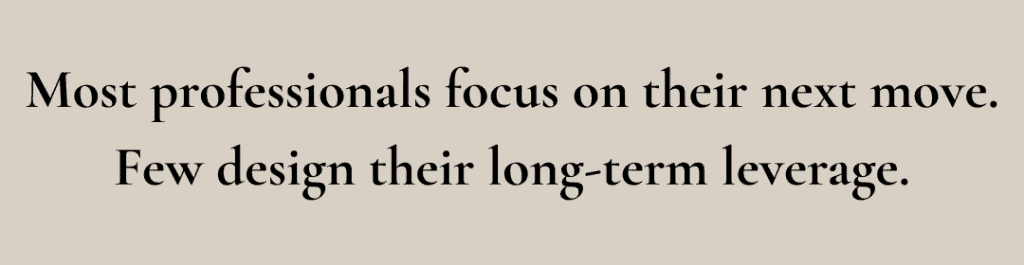
From my perspective, one of the most underrated career skills right now is the ability to think in years rather than quarters. Short-term wins feel good. They satisfy the part of us that needs immediate validation. But career positioning, the kind that makes you the go-to person in your field, builds income optionality, and gives you genuine professional authority, is a long game.
Compound progress works in careers the same way it works in finance. Each skill you build, each relationship you invest in, each piece of work you put into the world, it accumulates. The career achiever understands this deeply. They are planting trees they will sit under in five years while most professionals are chasing quick wins that disappear by the following quarter.
I think a really powerful point to note is this: strategic thinking is itself a skill. It is not natural for most people. It has to be practiced. Career achievers schedule time to think about their direction, not just to do their work.
Systems That Career Achievers Build
Skill Development System
The most resilient career asset you have is your skill set. Not your job title. Not your employer. Not even your network. Your skills. The World Economic Forum’s Future of Jobs Report 2023 found that 44% of workers’ core skills will be disrupted within the next five years. That is not a reason to panic. It is a very concrete reason to build a continuous learning system right now.
A career achiever identifies which skills are market-relevant today and emerging tomorrow, creates a structured plan to develop them, and treats that plan as a professional non-negotiable. This is the foundation of long-term relevance in the job market. Deliberate practice, focused, effortful learning with clear feedback, is what separates skill development that actually moves the needle from the passive consumption that most people call “learning.”
Quick tip: dedicate a minimum of 30 minutes each day to deliberate skill development in your highest-leverage area. Not scrolling LinkedIn. Not consuming podcasts passively. Focused, intentional learning. Over a year, that is more than 180 hours of compounding skill investment. That is significant.
I write regularly about skill development and how to turn what you know into income over at Learn Grow Monetize on Substack. If this resonates, you will find more depth there.
Productivity System
Time is the one resource that cannot be recovered. Career achievers protect it deliberately and design their days with intention. They use time blocking to assign their best cognitive hours, typically the first two to four hours of the workday, to their highest-value, most complex work. They manage energy, not just time, understanding that peak performance requires recovery, rest, and focus rituals as much as it requires output and effort.
Energy management is something most productivity conversations skip entirely. But the neuroscience is clear: sustained high performance depends on cycles of exertion and recovery. The career achiever is not always at maximum output. They are strategic about when they push and when they restore.
This is a great insight that changed how I plan my own week: every Sunday, I block my highest-value hours for the week ahead before anything else fills the calendar. Meetings, admin, and reactive work fill the remaining space. Not the other way around.
Accountability System
Here is an idea that shifted how I approach my own professional growth: treat your career like a business. A business tracks its metrics. It creates feedback loops. It reviews performance regularly and adjusts course based on evidence, not feelings.
Career achievers build accountability systems into their week. Whether that is a weekly review practice, a mentor relationship, a mastermind group, a peer accountability partner, or simply a personal tracking system for measurable outcomes, the structure matters. Without feedback mechanisms, you are operating without signal. You are putting in effort with no way to know whether it is moving the needle or not.
Research from Dominican University of California found that people who wrote down their goals, shared them with a friend, and sent weekly progress reports achieved 76% of their goals, compared to just 43% for those who did not. Accountability is not a soft skill. It is a performance tool.
Income Optionality System
This one is personal. After losing my husband, I understood with complete clarity that job security is not a paycheck from one employer. Real security is skill monetization, the ability to generate income from what you know in multiple ways, through multiple channels, independent of any single organization’s decisions.
Career achievers build income optionality into their professional lives. They explore freelance consulting, digital products, content creation, coaching, and teaching. They understand that skill stacking, combining two or three complementary skills into a distinctive profile, creates a professional identity that is harder to replicate and more valuable in the market than any single specialization alone.
7 Habits of a High Achiever in Modern Careers
The habits that separate a career achiever from someone who stays stuck are not secret. But they are specific, and they require decision, not just desire.
Strategic goal setting means connecting daily actions to a longer vision, not just setting annual targets that sit in a document and get reviewed once. Daily execution discipline means doing the work on the days you do not feel like it, which, if you are being honest, is most days. Skill stacking means building combinations of capabilities that make you distinctly valuable rather than generically competent in a crowded market.
Networking with intent means investing in relationships that are mutually beneficial and professionally strategic. Not collecting contacts. Building genuine connections with people whose work you respect and who respect yours. Regular reflection and review means pausing deliberately to assess what is working, what is not, and what needs to change, because the career achiever is always iterating, never just executing.
Adaptability means staying current as industries shift and not clinging to what worked five years ago. This is especially critical now, as AI reshapes entire categories of work at a speed most professionals are not prepared for. And long-term resilience means having the psychological and practical foundation to recover from setbacks, not just survive them, but extract insight from them and use them.
Based on personal experience, resilience is the most important habit on this list. And it is not a personality trait you either have or do not. It is a practice. It is built through small, repeated acts of pursuing your personal development goals and continuing when it gets hard.
Why Most Professionals Never Become Career Achievers
Comfort is seductive. Most professionals stay average not because they lack intelligence or work ethic, but because the discomfort of real growth is optional. You can avoid it indefinitely. You can still hold a job, still receive a salary, still look perfectly fine from the outside.
Fear of visibility keeps many capable people from building professional authority. They do not share their ideas publicly. They do not position themselves as experts. They do not create, publish, or lead, because being seen means being judged. And the possibility of judgment feels worse than the certainty of invisibility.
Reactive career decisions, jumping to the next role because you are unhappy rather than because it advances a deliberate strategy, produce lateral movement dressed up as progress. After five years of reactive moves, you are often no further along in terms of genuine career positioning, income optionality, or professional authority than when you started.
And the absence of a structured growth plan means that ambition stays an intention rather than a trajectory. I hold the view that this is the real career crisis most professionals face, not a lack of talent, not a lack of opportunity, but a lack of structure that converts ambition into compounding outcomes.
It seems to me that the gap between where most people are and where they want to be is almost never a talent gap. It is a systems gap.
Career Achiever vs High Performer: The Critical Difference
High performance can be sustained through sheer effort for a season. Many people do it. They grind through a launch, a promotion push, a difficult quarter. They produce results through raw intensity. And then they burn out. Because effort without architecture is unsustainable.
Career achievers build leverage. They create structures, skills, relationships, systems, content, reputation, that produce results without requiring them to operate at maximum intensity every single day. This is the difference between sustainable professional growth and the burnout cycle that traps so many ambitious people.
Hustle culture sells the idea that more is more. Career achievers know that smart, consistent, and strategic is more. Effort directed through systems compounds. Effort without systems exhausts. The high performer works harder every year to maintain the same results. The career achiever works smarter every year and produces compounding returns.
I am of the opinion that the shift from high performer to career achiever is one of the most important transitions a professional can make, and most people never make it, not because they cannot, but because no one shows them how.
How to Start Building Your Career Achiever System Today
Step 1 is to audit your current systems, or the absence of them. Look honestly at how you manage your time, your learning, your income streams, and your professional direction. Where are the gaps? Where are you operating reactively rather than by design?
Step 2 is to identify your skill gaps relative to where you want to be in three to five years. Not just where the market is today, where it is heading. The World Economic Forum’s skills disruption data makes this urgent, not optional.
Step 3 is to design your daily non-negotiables: the three to five actions that, done consistently, will move your career forward regardless of what else is happening around you. These are not aspirational. They are structural. They go in the calendar before anything else.
Step 4 is to create feedback mechanisms. A weekly review practice, a tracking habit, a mentor, a peer accountability partner who will tell you the truth. Without feedback loops, you cannot course-correct. You cannot know if your effort is producing the outcomes you intended.
Step 5 is to start building income leverage. Look at your existing skills and ask: how could these generate value beyond my current role? Consulting, freelancing, digital products, coaching, content. There are more paths than most professionals realize.
None of these steps require extraordinary talent. All of them require decision, consistency, and the willingness to treat your career as something you actively build rather than something that passively happens to you.
The Compound Effect of Career Achiever Systems
The career achiever who builds these systems and stays consistent for five years ends up somewhere genuinely different from where they started. Career resilience increases because they are not dependent on any single employer, role, or industry. Earning potential grows because their skills, professional authority, and reputation have compounded. They become the person others turn to, to hire, to promote, to partner with, to learn from.
Long-term relevance in a shifting job market is not luck. It is not charisma. It is the output of deliberate personal development, continuous learning, and the discipline to keep showing up when it is inconvenient.
I built this platform, and eventually the Sell Your Skills System, because I needed something that did not exist when I was rebuilding my life from scratch. A place where ambition meets practical strategy. Where professional growth meets skill monetization. Where you do not have to choose between being a thoughtful, whole human being and being a career achiever.
You can be both. You just need systems, not hope.
If any of this resonated, I share more of this thinking regularly at Learn Grow Monetize. Come find me there.
Frequently Asked Questions
What defines a career achiever?
A career achiever is someone who builds sustained professional growth through deliberate habits and systems rather than relying on external circumstances or short-term motivation. They prioritize skill development, strategic thinking, and long-term career positioning. The key distinction from a high performer is sustainability. A career achiever produces compounding results over time without burning out, because their growth is system-driven rather than effort-driven.
Can anyone develop an achiever mindset?
Yes. The achiever mindset is not a fixed personality trait. It is a set of beliefs and behaviors that can be developed through deliberate practice. The starting point is identity, choosing to see yourself as someone who grows consistently before the results are visible, and then building the daily habits that reinforce that identity. Research in behavioral psychology confirms that identity-based habit formation is one of the most reliable paths to sustained behavior change.
Is motivation necessary for career success?
Motivation is useful when it shows up, but it is unreliable as a primary driver of professional growth. Research consistently shows that habits, systems, and environmental design produce more consistent career outcomes than motivational feelings. Career achievers use motivation when it is available and do not wait for it when it is not. Systems are what make execution the default, not the exception.
How do systems improve professional growth?
Systems create consistency, and consistency produces compound growth over time. A skill development system builds market-relevant expertise continuously. A productivity system directs your best cognitive energy toward your highest-value work. An accountability system creates feedback loops that allow you to course-correct in real time. Together, these systems remove the guesswork from professional growth and make measurable progress repeatable rather than occasional.
What habits separate high achievers from average professionals?
Strategic goal setting, daily execution discipline, skill stacking, intentional networking, regular reflection and review, adaptability, and long-term resilience are the core habits that distinguish career achievers from professionals who plateau. The difference is not talent or intelligence. It is structured, sustained practice applied consistently over time, which is available to anyone willing to design their career with intention.

Read more in the Archive
Connect with me onLinkedIn for timely insights on building resilient careers and navigating the changing world of work.
Discover Learn Grow Monetize for practical career strategy, skill monetization insights, and real stories of professionals building new income streams.