Career Stuck But Don’t Want to Start Over? Good. Starting Over Is Rarely the Answer


Career stuck but don’t want to start over?
You’re not alone.
Here’s something no one tells you once you’re ten years into a career that no longer fits.
You don’t have to blow it all up.
You don’t have to quit your job, retrain for years, go back to school, or start again at the bottom. That’s the story people often hear about career change, and it keeps a lot of smart, capable professionals stuck exactly where they are.
Because if the only option is starting over, the risk feels too high.
So people stay.
They stay in roles they’ve outgrown.
They stay in industries that no longer excite them.
They stay because they believe moving forward means losing everything they’ve worked for.
But that’s not how most career pivots actually happen.
Most professionals don’t start over.
They reposition. They use the experience, skills, and knowledge they already have in a different way.
If you feel career stuck but don’t want to start over… financially, emotionally, or practically, then this is for you.

✨ Sign up to the newsletter for free
✨ Weekly insights on skills, careers, and monetizing expertise
✨ Real stories of professionals successfully pivoting careers
✨ Your welcome email includes the free Skill-to-Income Discovery Tool

Sign up in seconds. No spam. Unsubscribe anytime.
Glassdoor’s 2025 Worklife Trends report found that 65% of workers feel stuck in their current job. That’s not a personal failure. That’s a pattern, and patterns have causes.
I know this feeling from the inside. After personal tragedy struck at 36, with two babies and a mortgage, I had no choice but to rethink everything I thought I knew about security. The job I had banked on disappeared. The organization that I had worked for didn’t protect me. What I had left, the only thing no one could take, was my ability to learn, adapt, and turn what I knew into something people would pay for. That became my obsession. It became what I teach.
If you feel career stuck, don’t want to start over, and want a real plan for moving forward, keep reading.
Why So Many Professionals Feel Stuck in Their Careers
Career stagnation is not a niche problem. Indeed’s career change research shows that the majority of employees who want to change careers feel they lack the skills or visibility to make a move. Gallup’s 2024 State of the Global Workplace report found that only 23% of employees globally are engaged at work, with 15% actively disengaged. In the US and Canada, engagement sits at 33%, which still means two thirds of workers are going through the motions. These are not marginal numbers. They represent the majority of the working population.
The causes tend to cluster around a few patterns. A lack of progression, no new responsibilities, no promotions, no stretch goals, is one of the biggest. Economic uncertainty plays a role too, keeping people in jobs they’ve outgrown because the risk of moving feels too high. Skill stagnation is another: when you stop learning, your confidence drops, your market value stalls, and your options narrow. Then there’s burnout, which often gets mistaken for laziness but is usually the result of caring deeply about something for too long without enough support or reward.
Here’s what I’ve learned: most people who feel career stuck aren’t stuck because they lack ability. They’re stuck because no one ever showed them what their options actually are.
The Hidden Career Plateau Most Professionals Don’t Recognize
A career plateau doesn’t always look dramatic.
There’s no crisis moment. No pink slip. No blowup. It’s quieter than that.
You wake up and realize you’ve been doing the same job, with roughly the same responsibilities, for the last three years. You’re competent. You’re reliable. You have the skills. But you’re not growing. Your motivation has dropped without you really noticing. Your job satisfaction has quietly hit the floor. You’ve stopped learning. And without anyone saying it out loud, the opportunities have stopped coming your way.
This is what researchers call a career plateau, and it’s more common among mid-career professionals who feel stuck in their careers than most people realize. Indeed’s research on career plateaus confirms that employees who plateau experience drops in performance, morale, and motivation, and that the most common cause is a structural lack of growth opportunity, not personal failure. More than 20% of workers over 40 cite lack of opportunity as their biggest career barrier. The problem isn’t age. It’s visibility and positioning, both of which are things you can change.
I am inclined to think that the plateau gets missed precisely because it doesn’t feel like a crisis. It just feels like flatness. And flatness is easy to normalize. That’s what makes it dangerous for your long-term career growth and professional development.

The Myth That Career Change Means Starting Over
Let’s deal with this directly. The idea that a career pivot requires starting from zero is one of the most damaging myths in professional culture. It stops people who are career stuck from making moves that would genuinely improve their lives.
When a teacher becomes an instructional designer, they don’t start over. They apply their knowledge of how people learn to a new context, often a better-paid one. When a marketer moves into product marketing, they bring their understanding of audiences, messaging, and customer behavior. When an engineer moves into product management, they bring technical credibility that most product managers can’t match.
This is what I call career compounding, and it’s the core idea this whole approach is built on. Your experience builds on itself. The skills, the relationships, the judgment you’ve built, these don’t disappear when you change direction. They transfer. And often, they transfer with a premium attached.
Here’s an idea: instead of asking “what would I need to start fresh,” ask “what do I already have that someone else would pay for in a different context?” That single reframe changes everything when you’re feeling career stuck and want to pivot without losing ground.
5 Signs You Are Stuck in Your Career
Recognizing that you’re stuck in your career is the first step toward getting unstuck. These are the five most common signals that confirm you’re career stuck and need a new direction.
Your Skills Are No Longer Expanding
If you can do your job on autopilot, that’s not mastery, that’s stagnation. Career growth requires friction. When there’s no friction left, your skill development has stopped, and your market value is quietly eroding.
Your Role Has Become Repetitive
Doing the same tasks in the same way, year after year, is a signal. Not that you’re not good at your job, but that your job has stopped being good for you. Career progression requires novelty, challenge, and the chance to build new capabilities.
You Feel Disengaged From Your Work
Disengagement isn’t always burnout. Sometimes it’s simply a mismatch between what you’re doing and what you care about. Gallup’s research consistently shows that disengaged workers cost organizations in productivity, retention, and culture. On an individual level, disengagement is data. It’s telling you something important about your career direction.
Your Industry Is Evolving Faster Than You Are
This one is urgent. If your field is changing and you’re not changing with it, the gap grows every year. Skills that were valuable three years ago may already be losing value. Career mobility in a fast-moving market requires continuous skill development, not occasional updates.
You No Longer See Long-Term Growth
When you try to picture yourself in five years and the picture is just more of the same, that’s your gut signaling a career plateau. Career planning should excite you, at least a little. If it doesn’t, something needs to change.
Why Starting Over Is Rarely Necessary
Transferable skills are the most underrated asset in professional life. When you’re career stuck and looking to pivot, they are what you already have that will carry you forward. Communication, leadership, project management, analysis, problem solving, these travel across industries, sectors, and roles.
They don’t belong to a job title. They belong to you.
The reason people underestimate their transferable skills is because we tend to describe our experience in terms of tasks rather than capabilities. “I managed a team of eight” is a task. “I built the kind of trust that keeps a team together through difficult periods” is a capability. One looks like a job description. The other is a story about who you are and what you’re worth to a future employer in any sector.
From my perspective, this reframing is the single biggest shift for anyone who feels career stuck and wants to pivot without starting over. You are not your job title. You are not your industry. You are the skills, judgment, and relationships you’ve built, and those are portable. Indeed’s guide to transferable skills confirms that capabilities like communication, adaptability, and analytical thinking are valued across virtually every field.
The 4 Career Pivot Paths That Don’t Require Starting From Zero
When you’re career stuck and don’t want to start over, it helps to know exactly what your options look like. Most professionals who feel stuck in their career assume the only answer is a dramatic restart. It isn’t. There are four distinct pivot paths, and each one builds on what you already have.
Role Pivot
A role pivot means staying in your industry but moving into a different function. A finance professional moving from accounting into financial planning and analysis is a role pivot. Same world, different application of skills. This is often the lowest-risk career transition and a smart first move when you feel stuck in your current role.
Industry Pivot
An industry pivot means taking your skills into a different sector. A healthcare project manager moving into tech project management is an industry pivot. The industry changes; the core capability stays the same. This path gives you career mobility without requiring you to rebuild from scratch.
Skill Expansion
Skill expansion means adding a complementary skill that opens new doors without abandoning your current expertise. A writer who learns SEO, a designer who learns conversion principles, an HR professional who learns data analysis, each is expanding their professional value without walking away from what they know. This is also called skill stacking, and it’s one of the most effective ways to get unstuck in your career without a dramatic change. I write about this at Learn Grow Monetize, including a deep dive on the skills most likely to outlast AI disruption.
Portfolio Career
A portfolio career means building multiple income streams from your existing skills, consulting, fractional roles, writing, coaching, training. This model is growing fast. The portfolio model gives people genuine career options without forcing them to abandon what they’ve already built. You can see real examples of professionals doing exactly this in the Career Pivot Playbooks series on Substack.
How to Identify Your Transferable Skills
Start with a list. Not of your job titles, but of what you actually do well. Think about the problems people bring to you. Think about what colleagues ask for your help with. Think about the moments in your career when you felt most effective. What were you doing in those moments?
Then layer in your industry knowledge. Even if you want to leave your sector, you understand it, the language, the relationships, the pressures, the unspoken rules. That knowledge has value to organizations trying to reach or serve people in your former field.
Quick tip: don’t dismiss your professional network and reputation as soft things that don’t count. In a career pivot, they often matter more than your CV. The people who know your work are your fastest route to new opportunities in a new direction.
A structured approach to identifying your high-value skills is one of the most practical things you can do when you feel career stuck. I’ve put together a guide on high-income skills valued by employers that walks you through exactly this process, including how to identify what you’re actually worth in the current market.
The Career Compounding Framework
Here’s a simple framework worth keeping. Experience, plus skills, plus visibility equals opportunity. Most people work hard on the first two and completely neglect the third.
Visibility means being known for what you do well, outside the walls of your current organization. It means writing, speaking, connecting, and sharing what you know. It means building a professional presence that travels with you when you move. Without visibility, your skills remain invisible to the people who might pay for them.
This is a great hack: start building your visibility before you need it. The best time to establish your reputation outside your current role is when you’re not desperate to leave. Desperation is visible, and it works against you. Confidence and genuine curiosity are far more attractive to potential employers and clients. If you’re career stuck right now, building visibility is one of the highest-value moves you can make.
How to Pivot Without Losing Income
The goal is not to leap, it’s to move. Smart career transitions are usually lateral before they become vertical.
Internal moves are underused by professionals who feel career stuck. Many organizations are actively looking for people willing to move across functions, and an internal transfer lets you test a new direction while keeping your salary and institutional knowledge intact. It’s the lowest-risk career pivot available to most people.
Freelance work on the side lets you test a market before committing to it fully. Consulting gives you access to different industries without leaving your current one. Side projects let you build skills and a body of work that demonstrates capability in a new area. Fractional roles, where you work for multiple organizations in a part-time senior capacity, are growing fast, especially in marketing, finance, and operations.
Based on personal experience, the people who make the smoothest career pivots are the ones who treat it as a research project before they treat it as a decision. They don’t quit first and figure it out later. They build the bridge while still standing on solid ground.
If you want to explore how other professionals have done this without losing income or starting over, AI Automating Your Job? Here’s What To Do is a practical starting point.
Small Experiments That Help You Get Unstuck
If you’re career stuck, you don’t need a complete plan before you take action. You need small experiments that give you real information about what direction actually fits.
Take an online course in the adjacent skill you’ve been curious about. Write one piece publicly about what you know. Reach out to three people working in a role or sector that interests you and ask them how they got there. Take on one freelance project. Attend one event outside your current industry.
Each experiment costs very little in time or money. Each one teaches you something real about what you actually want, as opposed to what you think you want from behind the safety of your current position.
Insightful tip: the professionals who get unstuck fastest are rarely the most strategic planners. They’re the ones willing to take small, low-stakes actions consistently. Momentum builds from motion, not from planning. If you’re career stuck, the answer is almost always to do something rather than think something.
How Long a Career Pivot Actually Takes
Realistically, most people who are career stuck and want to pivot without starting over complete their transition within six to eighteen months. The range is wide because it depends on how big the skill gap is, how strong your network already is, and how much time you can invest alongside your current job.
The stages tend to follow a consistent pattern. Exploration is first, where you figure out what direction genuinely interests you. Skill acquisition comes next, where you close the specific gaps between where you are and where you want to go. Repositioning follows, where you start describing yourself and your experience differently to reflect the new direction. Opportunity creation is the final stage, where the new doors begin to open as a result of the work done in the earlier stages.
The people who stay career stuck the longest are the ones who treat a pivot like a decision rather than a process. Career transition is not one big choice. It’s a series of smaller choices that accumulate into a meaningful shift in direction. Thinking about a career pivot in stages makes it far less overwhelming, and far more achievable.
The New Career Security
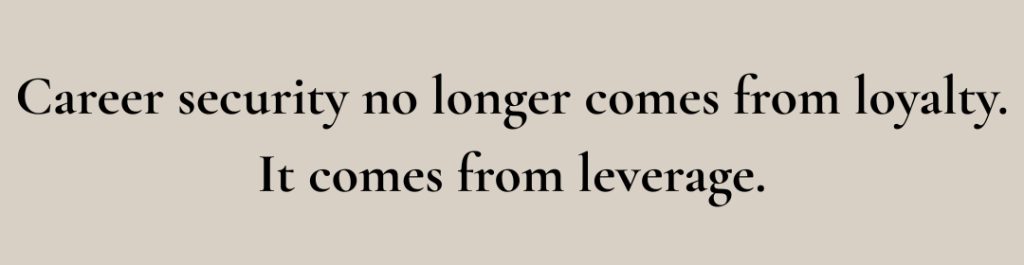
Here’s the hard truth for anyone career stuck in 2025. The old model said: stay loyal, work hard, and your employer will protect you. That model is gone. Most people already know this, even if they haven’t fully adjusted to what it means for their career planning.
The new model is skill security. The people who are most protected in a changing economy are not the ones with the longest tenure or the most impressive titles. They are the ones who keep learning, keep adapting, and keep building capabilities that solve real problems for real people.
Gallup’s research consistently points to skill development and growth opportunities as among the strongest drivers of engagement and retention. The World Economic Forum ranks learning agility as one of the most valuable traits in the modern workforce. The pressure to upskill and reskill is now one of the top priorities for employers and individuals alike. I am convinced that the ability to learn, and to keep learning, is now the most important career skill there is. More than any specific technical knowledge, and more than any degree.
I learned this the hard way. Jobs don’t equal security. Titles don’t equal safety. Systems can disappear overnight. What stays with you, always, is your ability to learn, adapt, and turn your skills into value people will pay for. That’s the only career security and real job security that holds up in a changing economy. I wrote more on this in AI Is Accelerating: Human Skills Are Leadership’s New Currency, which explores what the shift to skill-based security actually looks like in practice.
When Starting Over Actually Makes Sense
There are cases where a more complete restart is the right call, and it’s worth being honest about them.
If your industry is genuinely contracting, not just going through a rough patch, but structurally shrinking, staying in it regardless is not loyalty, it’s stubbornness. If you’ve experienced severe burnout that has fundamentally changed what you can tolerate in a work environment, pushing through in the same direction can cause real harm. If your values and the values of your profession have genuinely diverged, no amount of career repositioning or professional reinvention will fix that underlying mismatch.
But these cases are rarer than people think. Most career dissatisfaction is not a values crisis. It’s a positioning problem, a visibility problem, or a skills problem, all of which are solvable without burning everything down. If you’re career stuck and unsure which category you fall into, working through your personal development goals is a useful starting point for clarifying what you actually want from your next chapter.
The Strategic Mindset That Future-Proofs Your Career
The professionals who will do best over the next decade are not the most credentialed or the most experienced. They are the ones with the highest learning velocity, the ones who can pick up new skills faster, adapt to new contexts more easily, and spot opportunities before others do.
This means prioritizing learning over comfort. It means building skills that give you options, not just skills that serve your current role. It means maintaining visibility even when you’re happy where you are. And it means treating your career as something you actively manage rather than something that happens to you.
Here’s what I’ve learned: the professionals who feel the most career stuck are almost always the ones who stopped investing in themselves at some point and then suddenly needed options they hadn’t built. Career planning is not something you do when you’re in crisis. It’s something you do consistently so you never have to start from scratch.
You build your options long before you need them. That’s the whole game. And if you’re reading this because you feel career stuck right now, you’ve already taken the first step.
If this resonates with where you are right now, I’d love for you to keep reading at Learn Grow Monetize on Substack, where I write every week about career strategy, career coaching frameworks, skill positioning, and building income from what you already know. You’ve worked hard to get where you are. The goal now is to make sure that work takes you where you actually want to go.
Frequently Asked Questions
Why do people feel career stuck?
Research from Indeed and Gallup shows the most common causes are limited growth opportunities, lack of skill development, and low engagement at work. Career stagnation is structural as much as personal. If your role has stopped asking anything new of you, your development has likely stopped too, and that affects both your motivation and your market value over time.
Is it possible to change careers without starting over?
Yes. Most successful career pivots rely on transferable skills rather than a complete restart. The key is identifying what you already do well and finding contexts where those capabilities are in demand. A role pivot, an industry shift, or a skill expansion can all open significant new opportunities without requiring you to start from zero. Research from Hiring Hub found that 64% of job switchers changed occupations entirely while still building on existing experience and skills.
How long does a career pivot take?
Most career transitions take between six and eighteen months. That timeline depends on the size of the skill gap, the strength of your existing network, and how much time you can invest alongside your current role. The pivot rarely happens in a single moment, it’s a series of small moves that accumulate into a meaningful career shift over time.
What are transferable skills and why do they matter when you are stuck in your career?
Transferable skills are capabilities that apply across roles and industries, communication, leadership, project management, analysis, and problem solving. They matter because they belong to you, not to any particular job title or industry. In a career pivot, these skills are often more valuable than specific technical knowledge, because they signal how you think and work, not just what you’ve done before. Indeed’s transferable skills guide is a practical place to start mapping yours.
How do I know if I need a career pivot or just a new job?
If the problem is your specific role or organization, a new job in the same field may be enough. If the problem is the type of work itself, the industry, or a deeper mismatch with your values or interests, a more deliberate pivot is worth exploring. Small experiments, informational conversations, freelance projects, online courses, are usually the fastest way to tell the difference between needing a new employer and needing a new direction entirely.
Read more in the Archive
Connect with me on LinkedIn for timely insights on building resilient careers and navigating the changing world of work.
Discover Learn Grow Monetize for practical career strategy, skill monetization insights, and real stories of professionals building new income streams.